

Written by Fredrick izuogu for Bella digital…
Welcome
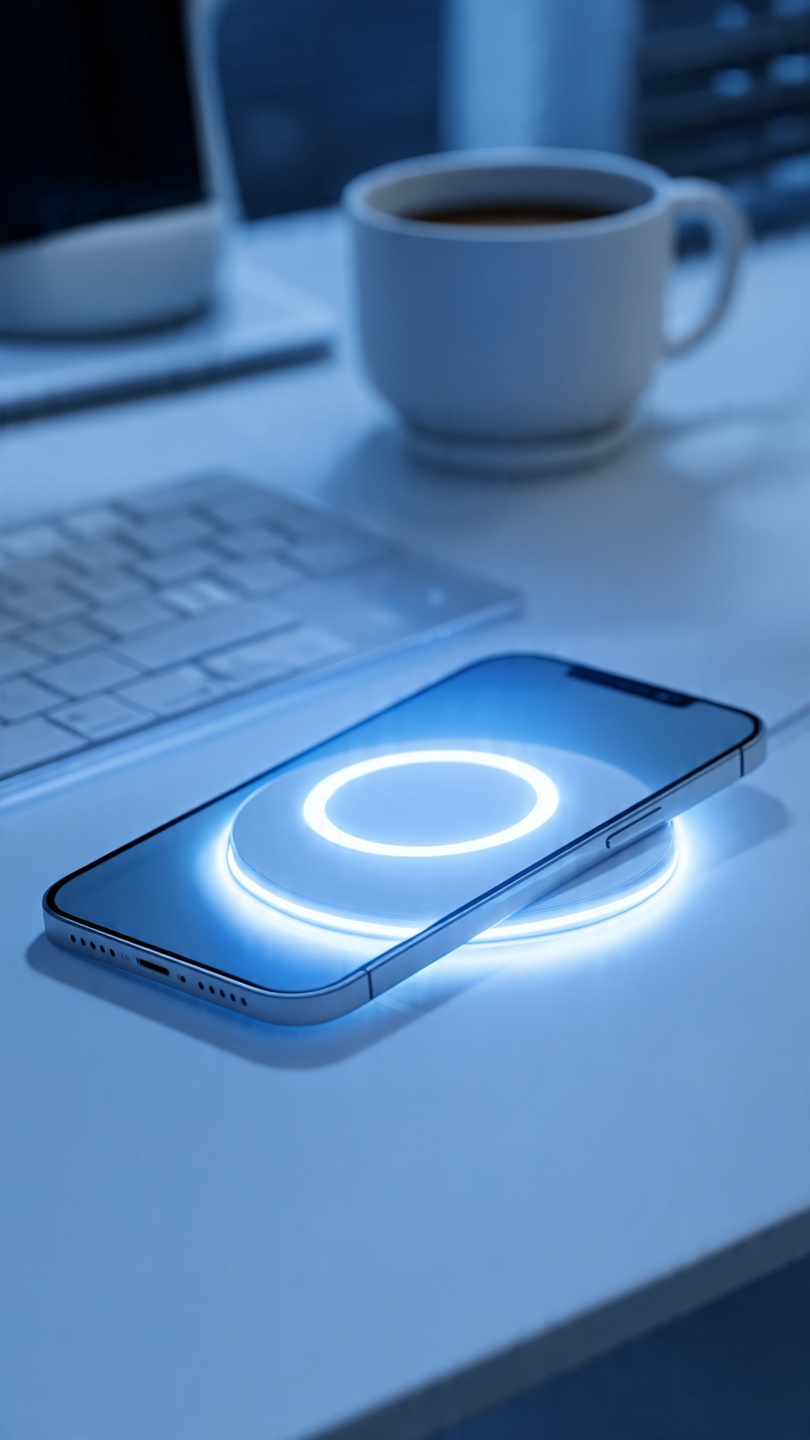
Wireless charging = powering devices without plugging in a cable. It uses electromagnetic fields to transfer energy between a charging pad and your device.
How it works – the basics
Most consumer wireless charging uses inductive charging:
- Charging pad has a coil that creates an alternating magnetic field when plugged in
- Device has a receiver coil. That magnetic field induces an electric current in it
- That current charges the battery
Think of it like 2 coils “talking” through a magnetic field. The coils need to be pretty close — usually <5cm apart.
There’s also resonant charging and RF charging which can work over slightly longer distances, but inductive is what’s in phones today.
Standards you’ll see
- Qi: The big one. Used by iPhone, Samsung, Google Pixel, etc. Qi2 is the new version with magnets for perfect alignment — like MagSafe.
- Qi2 / MagSafe: Adds magnets so your phone snaps to the exact right spot. Faster and more efficient.
- PMA: Older standard, mostly phased out.
- AirFuel Resonant: Can charge through thicker surfaces and multiple devices at once.
What’s innovative about it right now
- Faster speeds: Went from 5W in 2012 to 15W Qi, and up to 50W with proprietary standards like OnePlus/Samsung. Qi2 pushes 15W efficiently.
- Longer range: Companies are testing “true wireless” charging that works 1-3 meters away using RF and magnetic resonance. Not mainstream yet.
- Multi-device pads: One mat that charges phone + watch + earbuds at the same time, each at full speed.
- Reverse wireless charging: Your phone becomes the pad. Used to charge earbuds or a friend’s phone.
- In-car + furniture integration: Built into car dashboards, desks, coffee tables.
- EV wireless charging: Big pads in your garage floor. Park and charge without plugging in. BMW and others already tested this.
Pros
- Convenience: Drop and go. No cable wear
- Waterproofing: Fewer ports = better water resistance for phones
- Public charging: Cafes, airports, buses adding Qi pads
Cons
- Slower: Still generally slower than wired fast charging, and wastes ∼20-30% more energy as heat
- Heat: Can make phones warm
- Alignment matters: Off by 5mm and charging slows/stops. That’s why magnets in Qi2 help
- Cost: Pads + cases cost extra
What’s coming next
- Spatial charging: Charge multiple devices anywhere in a room. Motorola and Xiaomi demoed this.
- Long-range for IoT: Sensors, smart home devices that never need batteries swapped
- Road charging for EVs: Roads with embedded coils to charge cars while driving
Most people use it for overnight charging or convenience charging at a desk. For speed, wired is still king.
Wireless charging has gone from “cool gimmick” to actually useful in the last few years. The big innovation is: power without plugging in.
Let’s take a deep look how it’s evolving:
1. The core innovation: No cables, just proximity
Instead of metal pins, it uses magnetic induction or resonant charging.
You put your phone/watch/earbuds on a pad and coils create a magnetic field that transfers energy.
Qi is the standard most phones use now.
2. What’s new and getting better in 2025-2026
A. Speed catching up to wired
Early wireless was 5W and slow. Now we have 15W Qi2, 25W, even 50W on some Androids. Qi2 uses magnets like Apple’s MagSafe so alignment is perfect = faster + less wasted energy.
B. “Drop and charge” magnets – Qi2 / MagSafe
Magnets snap your phone to the exact right spot. No more wiggling it on the pad. This also enables wallets, stands, and car mounts that charge at the same time.
C. Multi-device + reverse charging
- Charging pads for 3 devices: phone + watch + earbuds on one pad
- Reverse wireless charging: Your phone can charge your earbuds or friend’s phone. Super handy in a pinch.
D. Longer range / “true” wireless
Companies are testing charging across a room, not just touching a pad. Using radio waves or infrared. Still early and low power, but the idea is: walk into your room and devices start charging automatically.
E. Built into everything
- Cars: Center console pads are standard now
- Furniture: Tables, desks with charging built in
- Public places: Airports, cafes, buses in Port Harcourt are starting to add pads
- Home appliances: Some smart toothbrushes, keyboards, mice already do this
3. Why it matters
Benefit What it means for you
Convenience No more hunting for cables. Just drop and go
Less wear and tear Phone ports don’t get damaged or collect dust
Water resistance Fewer openings = phones can be more sealed
Cleaner setup One pad instead of 3 cables on your desk
4. Downsides still being worked on
- Efficiency: Wireless wastes ∼20-30% more energy as heat vs cable
- Heat: Can make phones warm if misaligned
- Speed: Top wired charging is still faster, especially for laptops
The future direction
The innovation push is toward “spatial charging” — charge multiple devices anywhere on your desk, and eventually across a room. Combined with Qi2 magnets and faster speeds, the goal is for you to never think about plugging in again.
It’s basically moving us from “charging as a task” to “charging as background.”
Knowledge is power so I hope this information helps you… Thanks
