

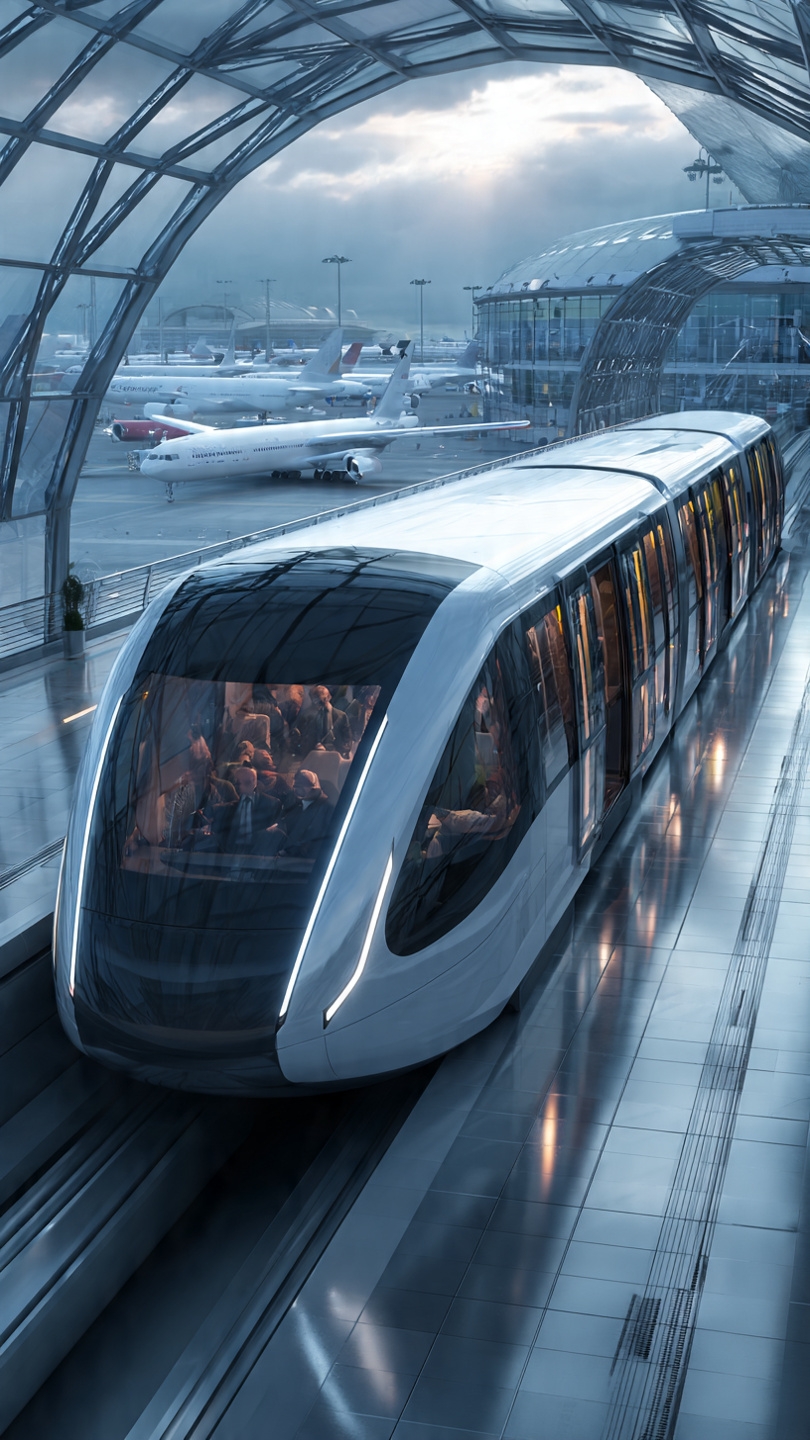
Written by Fredrick izuogu for Bella digital
Let’s start by looking at beauty of air train
1. The view
This is the biggest one. Because air trains are elevated, you’re above traffic, above buildings, above the noise.
You see the city from a new angle — rooftops, rivers, sunset over Port Harcourt, the whole grid of life below you. It feels calm and cinematic, like you’re floating.
2. The smoothness
Maglev and modern monorails barely touch the track. No clunk-clunk of wheels.
It’s a quiet, gliding feeling. You sip coffee and watch the world drift by instead of being stuck in traffic.
3. The hope of it
Air trains feel futuristic. They say “we can build up, not just out.”
Less land taken, less traffic, cleaner air. Cities like Tokyo, Chongqing, and Dubai use them to move millions without clogging the streets. It’s engineering that respects the city.
4. The feeling inside
- Light: Big windows, open sky, less tunnel
- Space: Stations feel airy because they’re up high
- Time: Commute becomes decompression time. You’re moving but also still.
There’s something deeply peaceful about watching a city go by from above while you’re not driving, not stressed, just moving.
The beauty isn’t just technical. It’s emotional.
An air train turns “getting from A to B” into a few minutes of perspective. You literally rise above the chaos.
An inward learning about air train
- Airport Air Trains / Automated People Movers (APMs)
This is the most common use today. Think JFK AirTrain, Heathrow, etc.
Innovation: Driverless, elevated trains that shuttle people between terminals, parking, and city links without mixing with road traffic.
- Delhi’s upcoming APM: India’s first “air train” is being built at Indira Gandhi International Airport. 7.7 km, 4 stops: T1, T2/3, Aerocity, and Cargocity.
- Why it matters: Fully automated, driverless system meant to cut travel time, remove DTC buses between terminals, reduce walking, congestion, and carbon footprint. Target: operational by end of 2027.
- How APMs work: Run on a dedicated elevated or underground track, frequent service, no driver.
- Clip-Air: The “detachable plane-train” concept
Swiss EPFL university proposed merging rail and air.
Innovation: Instead of boarding at a gate, you board a capsule at a train station. The capsule — about 30m long, like a rail car — rides by rail to the airport, then gets clipped under a plane’s wings to fly. Up to 3 capsules per plane, 150 passengers each.
Goal: More flexibility, and potentially 50% CO2 reduction because one plane structure can carry what 3 A320s carry with half the engines. Still considered “very futuristic” but technologically feasible. - Hovertrains / Air-cushion trains
Aérotrain (France, 1960s-70s): Invented by Jean Bertin.
Innovation: Used hovercraft tech — pumped pressurized air to lift the train off a concrete “inverted T” track so it never touched the ground. No friction = less wear and high speed.
- The I80 prototype hit 430.3 km/h / 267.4 mph, using aircraft turboshaft engines and propellers. Basically “little airplanes” on a track.
- Project was dropped due to conflicts with SNCF who preferred improving conventional rail.
Modern take: Monorail Air Cushion Ultra High Speed (MAC-UHS)
Proposes lightweight aircraft-style vehicles that ride on wheels at low speed and on air cushion at high speed, with electric linear motor propulsion. Claims it could cut infrastructure cost and build time by >10x vs conventional HSR. cfab
- Atmospheric / Pneumatic trains
Old idea revived: use air pressure differences to push trains.
- Brunel’s 1800s Atmospheric Railway: Cars had no engine, moved by air pressure in a tube. Failed within a year.
- Flight Rail concept: Vacuum ahead, pressure behind a piston magnetically coupled to passenger modules. Pilot model did 25 mph, full-scale goal >200 mph. Project suspended in 2024.
- Other “air train” innovations
- CO2-capturing trains: Researchers propose train cars with vents that take in air at speed, capture CO2, and store it. No fans needed because the train’s motion pulls air in.
- Aeroplane “Sky Trains”: US startup towing autonomous cargo gliders behind normal planes. Claims it could cut delivery from days to hours and operating costs by double digits.
The common thread of “innovation”
Most air train ideas try to solve the same 3 problems: friction, transfer time, and emissions.
- Remove friction – air cushion/hovertrain, linear motors
- Seamless transfer – Clip-Air capsules, APMs linking terminals
- Efficiency – fewer engines, shared structures, capturing energy from motion
We know this article would not just inform you but educate as well… Do come around often to read from us… Thanks
